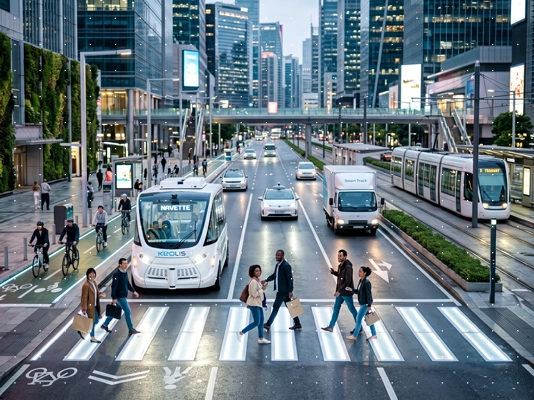
A city of the future with zero road accidents?

Pulse

What if the city of the future were a city without traffic accidents?

With artificial intelligence promising to make cars, buses, lorries and even cities ‘smart’, is it realistic to hope that it will also eradicate road accidents, which to this day remain the intolerable collateral damage of road transport?

Is “zero accidents” a realistic goal or an unattainable ambition?

Since the dawn of the motor car and throughout the century that has gradually cemented it as an unavoidable mode of transport, road traffic accidents have been regarded as a negative but inevitable externality. According to the World Health Organisation (WHO), road traffic accidents cause around 1.19 million deaths worldwide each year – in other words, more than 3,200 deaths a day. Yet urban planners, engineers, computer scientists and artificial intelligence researchers now argue that road deaths can be drastically reduced through the development of autonomous vehicles, smart cities and new technologies in general. Is ‘zero accidents’ therefore a realistic ideal – or a pipe dream?

The first argument is well practised by the advocates of artificial intelligence: if to err is human, simply remove the human from the equation and you will have no more errors. Accidents occur often as a consequence of the driver’s fallibility.

Since they are a human being, a driver may be distracted, under the influence, aggressive or less attentive. A quick glance at their phone, a lapse in concentration, then the crash, the crumpling of metal and the often disastrous consequences. The same WHO report concludes that the vast majority of road deaths could have been prevented. Behind the wheel, artificial intelligence will not become tired, irate, drunk, distracted or impatient. All it will do is process vast amounts of data in barely milliseconds, reacting far more quickly than even the most skilled Formula 1 driver could.

Where humans show their limitations, AI is already one step ahead: its reaction times are shorter, from about one second for a human to milliseconds; it always keeps its focus on the road, whereas the human mind can wander; at every moment, it assesses its surroundings using the cameras, sensors, radars and lidars fitted to autonomous vehicles; finally, its reactions are more consistent and predictable than those of even the most composed driver with a beating heart.

Can new technologies prevent accidents?

For some researchers and manufacturers, the goal of ‘zero accidents’ is no longer a utopian ideal, but a technical problem like any other, and one that therefore can be solved.

Among the works to have shaped this vision is a 2019 article by Amnon Shashua, founder of the Israeli company Mobileye – a world leader in collision-avoidance systems and driver-assistance technologies – alongside two other researchers. Entitled Vision Zero: Provable Safety – A Method to Eliminate Road Accidents without Compromising Traffic Throughput, the paper, which has become a key reference in debates on autonomous driving, sets out a particularly ambitious promise: “We propose an economical, viable approach to eliminate almost all car accidents.” In the space of a few pages and through a mathematical demonstration, the article outlines an approach by which road accidents could, in the long term, become the exception and not the inescapable rule.

Seven years on, as autonomous vehicles are gradually being rolled out in several cities around the world, this text provides valuable hindsight with which to compare this promise against the first experiences. There has been genuine progress, but it also highlights the pure complexity of the transition from mathematical proof to reality.

And yet the real revolution lies in the shift in perspective. For generations, innovations in road safety – from seatbelts to airbags – have been aimed primarily at helping passengers survive an accident. With technology and mathematics, the paradigm is shifting: by optimising the distances between vehicles and making their behaviour more consistent and predictable, the aim is no longer simply to limit the consequences of an accident, but to prevent it from happening in the first place.

Whilst the first accidents involving autonomous cars have received widespread coverage, large-scale trials are also showing encouraging results in terms of safety. After all, long before the advent of driverless cars, driver-assistance systems had already hatched major breakthroughs: collision warning systems, automatic emergency braking, adaptive cruise control, lane-keeping assist - to name but a few. As the automotive industry and road transport in general advance, change and improve, the number of accidents should naturally continue to fall.

Such is the state of play for driving and vehicles. But technology and data can transform road safety in terms of the traffic actually on the road.

This is the principle that lies behind ‘smart cities’: digital infrastructure connected to a multitude of sensors and cameras capable of monitoring, analysing and directing road traffic in real time. The traditional model used to contrast vehicles – which are, by their very nature, mobile (cars, buses, lorries, two-wheelers) – with fixed infrastructure (roads, roundabouts, signs, traffic lights). But digital technology has overturned this distinction, making the latter more adaptable. Today a traffic light sequence can be adjusted in real time, depending on volumes of traffic or weather conditions. If a tree blows over and falls across the road, sensors may in future be able to report it before a vehicle even reaches it; failing which, the first driver to come across the obstacle will be able to immediately notify all those following behind.

It is also at this level – even before a human or robotic driver is involved – that new technologies can prevent accidents: before situations even arise! Whilst the capacity to process and transmit data already exists, we are on the cusp of a revolution in the sensors that produce this data: so-called ‘Vehicle-to-Everything’ (or V2X) communication, i.e. between vehicles and the rest of the world. Thus, in the not-too-distant future, every vehicle will be able to communicate continuously with other vehicles on the road, the roads themselves, the emergency services, traffic lights and even pedestrians in the vicinity – provided they are also carrying connected devices. The aim is to anticipate and mitigate any risks or unforeseen events in advance, thereby ensuring greater peace of mind for all road users.


Does a smart city also become more vulnerable to cybersecurity challenges?

Between theory and practice, and despite the progress made, the most ambitious promises should be taken with a pinch of salt. Indeed, Mobileye and Amnon Shashua have still not eliminated car accidents, despite the years that have passed since the publication of their seminal paper –not that this has prevented their company from being valued at over 17 billion dollars in 2024. Although this vision has yet to fully materialise, Mobileye has established itself as one of the major players in autonomous driving.

Perhaps the question is not whether or not our societies could simply eradicate road accidents altogether, but why this remains unlikely or impossible, at least for the time being. Firstly,

there is the issue of trust: the first accidents involving autonomous vehicles were well publicised by the media, and many people – by force of habit - remain reluctant to get into a car without a human holding the steering wheel. It will take years of testing and certification, coupled with a massive reduction in both the number of accidents and their media fallout, for the autonomous car to become the norm. Secondly, accidents will only truly disappear once autonomous driving systems and all the sensors involved are better able to cope with extreme weather conditions, poor road surface condition and all of life’s unforeseen events. There are also risks linked to cybersecurity: connected computer systems mean the possibility of hacking, and therefore increased vulnerability. Is a smart city, almost by its very nature, the easiest type of city to attack? Finally, this accident-free future will also have to contend with the harsh realities of the present: the construction of new infrastructure and the development and subsequent roll-out of new sensors all cost money - a great deal of money, too much money at a time of ever-tighter budgets.

Optimists and advocates of road automation can point to certain historical parallels: after all, technology and the gradual integration of IT tools helped bring about massive progress in civil aviation at the turn of the 21st century. Air crashes do still occur, but in fewer number today than 30, 50 or 80 years ago. For autonomous mobility, the same type of goal might be more realistic, even if the promise it holds is less grandiloquent. As mentioned above, given the 1.19 million global road deaths each year, this type of road safety revolution could save hundreds of thousands of lives. Perhaps, with computing and artificial intelligence, we are on the cusp of a new era of road transport, based on data and the coordination of different vehicles, rather than on the freedom and independence of each individual vehicle. And maybe a new era for public transport, too, once the adulation of the private car has become a thing of the past… Perhaps road accidents will always happen, but they will be so rare that future generations will look back on these decades of carnage with the same bewilderment we feel today towards other bygone technologies that with hindsight we consider too dangerous - such as Zeppelin airships?