

How do you envision a traveler's journey in 2040?

“From a technological standpoint, we can do just about anything”
Pulse : How do you see a typical traveller’s journey in 2040? In what ways will this experience be similar to, or different from, those of today?
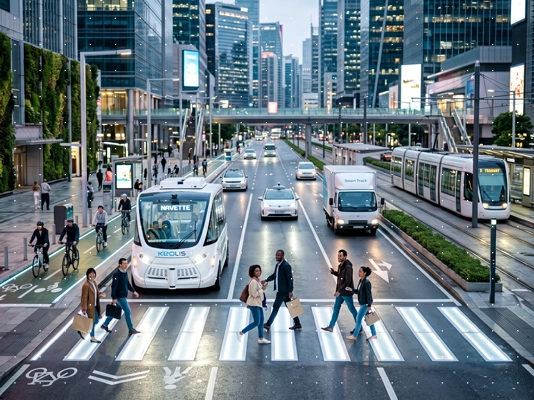
Alexis Jovignot : When you’re thinking about mobility in 2040, you’re already looking at what’s coming up in the forthcoming invitations to tender. 2040 may seem a long way off, but in terms of operation and maintenance contracts, it’s barely two contract durations away. In terms of the transport services provided, I wouldn’t expect a revolution. With urbanisation and cities becoming denser, we will still need high-capacity modes of transport – trains, metros, buses and light rail – to meet the travel needs of most people. Indeed, any local authority that wants to be ready by 2040 will have to start building a tram or metro line today. Where transport provision is likely to evolve will be in two areas: the energy transition, with the widespread electrification of all modes of transport; and the complementary use of different modes to serve less densely populated communities. We will need to invent new forms of mobility, and here I am a firm believer in autonomous mobility. The technology is ready. There will be robot taxis in Paris by 2040 – there’s no doubt about that – but I can’t see Keolis operating millions of robot taxis. On the other hand, autonomous shuttles could provide an appropriate solution for rural areas, outlying neighbourhoods or business parks at 5 am, for example. Their role will primarily be to fill out the existing service offering and bridge the remaining gaps in the network.
Julien de Labaca : I don’t think the way people travel will be fundamentally different. What has already been set in motion is being multimodal on the one hand – choosing different modes of transport depending on the day and our needs – and intermodal on the other – combining several modes during a single journey. After all, it will never be possible to run trains and buses everywhere, while car use is continuing to decline in city centres. One of the challenges in the coming years will therefore be to make journeys increasingly simpler and smoother. Today, in France, there’s still room for progress: passengers are still in doubt as to whether they can take their bike on the train, if they will find a free space in a cycle park, or if their on-demand transport (TAD) will turn up at the station, and, more broadly, how to get the right information effortlessly, and ideally in real time. I hope that by 2040 these issues will have been ironed out and that journeys will flow naturally, without any disruption or friction between different modes of transport: that everything will be seamless. In short: more service provision, definitely, but even easier to use!
AJ : In my view, from a transport demand perspective, passengers will experience several changes in the way they travel. The most significant is to do with the introduction of artificial intelligence. To plan their journey, passengers currently have to download an app, check timetables or get the information they need at the actual bus stop. But if the bus is running late, and the passenger has reduced mobility, for example, they won’t be offered any alternative solutions. AI can improve the clarity of information by providing contextualised, individually tailored details, bringing people a ‘mobility buddy’.
JdL : AI is a powerful tool, but we should bear in mind that today, 70 per cent of people find it hard to understand a transport network map. And that’s not just older people or those with cognitive impairments. That’s 70 per cent of the whole population! As a result, many functions may be made easier to use thanks to chatbots. And where the data is available, it could even be entirely conceivable to cope with the heatwaves such as those we had over the summer this year in France. The heat issue could be addressed by AI: imagine pedestrian or cycling trip planners that factor in the temperature or shaded areas depending on the time of day or the height of buildings. On that note, to power these systems, lots of good quality data needs to be generated, failing which AI won’t make any difference !
Pulse : Is what you’re describing ultimately a natural extension of Mobility as a Service (MaaS) – a conceptual framework that came to the fore in the 2010s?
JdL : My personal view is that MaaS was boiled down too quickly – and in purely conceptual terms – to ‘let’s stick everything on the phone’. The reality is a little more complex! To implement MaaS, you need to go back to basics, and therefore to the services provided. We’re starting to see a quite substantial array of solutions, and it could be said that, from a technological viewpoint, we can do just about anything: buses, bikes (both electric and traditional), metros, robot taxis and so on. But you need the resources to deploy these services, and people must be able to access and use it. There’s no justification for cramming everything into our phones if that doesn’t meet our real needs.
AJ : Transport networks have indeed taken their services and integrated them into mobile apps that give passengers the opportunity to search their route, buy a ticket, and so on. Looking ahead fifteen years, the added value of a transport operator won’t be measured by its ability to develop mobile apps. We won’t be trying to compete with the ultra-bespoke solutions of AI agents; however, the role of the operator and the local authority will remain central, because they are the only legitimate sources that can provide the correct information. As operators, we have full control over the systems we operate; we have the best information on timetables and ticket sales. We guarantee the value of all this data. Could we not make it available to other players, who are better placed than us to aggregate and utilise it? Local authorities must remain the producers of the data, and the operator the distributor, in a secure and open approac.
JdL : For me, the best rail network in the world is in Switzerland – it’s even better than Japan. But the paradox, thus far in the country, is that it’s not a case of ‘use your smartphone to do everything’. Instead, on the one hand, there’s a scheme called the ‘general travelcard’ costing 3,000 Swiss francs a year (3,995 in 2026 - Ed.) to travel on all the trains in the country. And on the other hand, there’s the SBB CFF app – in my view, the best in the world – which offers rich, detailed, real-time passenger information… but cannot be used as a travel ticket in its own right. You still carry a contactless card around with you. This ‘card+app’ combination calls on a monumental effort in data management and fare zone coordination, on a national scale. We’re not just talking about an ‘IT concept’ here. Ultimately, this is where many have gone wrong, by trying to implement MaaS without getting their hands dirty with the data. The Swiss example is a great source of inspiration.
Pulse : We hear a lot of talk about apps, data and artificial intelligence, but aren’t we in danger of losing sight of the human dimension of mobility in general, and public transport in particular?
AJ : It’s absolutely vital to still be talking about a human presence in 2040. We can anticipate that there will be less of a digital divide than in recent years, as entire generations of people will be conversant with smartphones. We will become increasingly digital, but effortlessly, just like when my six-year-old daughter uses her smart speaker to pick what music to listen to in her bedroom. It’s a natural reflex. For every stage of trip planning, from choosing the route to buying a ticket, there will be virtually no human involvement; instead, there will be bots or avatars to turn to if needed. However, there will always be a need for a human presence on the ground whilst travelling. If there’s a problem on the network, how are things likely to evolve in the next five or fifteen minutes? How are connections guaranteed? Staff, such as the SNCF’s ‘red vest’ helpers in stations, lend credibility to the response precisely because they are recognised as trustworthy. They will be supported by artificial intelligence and will provide the essential information needed to reassure and guide customers in difficulty.
JdL : A full six years ago, I wrote an article entitled ‘Rehumanising Mobility’. I believe the top priority is to transform the jobs of everyone who used to provide passenger information, whether at ticket counters or elsewhere. Digitalisation is one thing, but what do we do about the jobs that will be lost as a result of this digitalisation? A few years ago, a Belgian colleague proposed the creation of ‘Mobility Angels’, who could assist users with booking on an app, unlocking a free floating scooter outside the station, finding out about how to use a car-sharing service, and so on. I loved the idea. I have another tangible example: I’m currently working today with ADEME (the French Environment and Energy Management Agency - Ed.) to transform tourist information centres into ‘tourist and mobility information centres’. We’ve observed that when people arrive somewhere unfamiliar, there’s no single point of contact for transport and mobility queries: electric charging points are managed by the Department council, buses by the greater city council, longer distance coaches by the regional council, and the main vocation of the town hall isn’t necessarily to recommend the best commute to each of its residents.
Our concept is to ‘wire up’ tourist information centres with mobility-related information, turning them into ambassadors for mobility in their community. Alexis quite rightly spoke of the customisation possibilities offered by AI, and, as he also pointed out, this ultra-personalisation is never as effective as when embodied by a human being. Someone who knows about the solutions off the beaten track, who can take unforeseen circumstances into account and assess risks where necessary… Different, augmented content that doesn’t come from a machine. And if subsequently the ‘machine’ wishes to use this information through AI, then so be it!